EfVET, European Forum of Technical and Vocational Education and TrainingSafety AcademiaVocational College, TbilisiSafety Academia
EfVET ANNUAL CONFERENCE 2026 · WORKSHOP

Slides

Swipe through the presentation on your own phone.

Swipe sideways, or use the arrows. Tap a slide to view it full screen. This is the discussion part of the deck; the exercises have their own pages. Open the exercises.

Slides showing figures and facilitator-only slides are not included here.
Slide 1: Welcome: safety is the foundation of green and fair work.
Welcome: safety is the foundation of green and fair work.
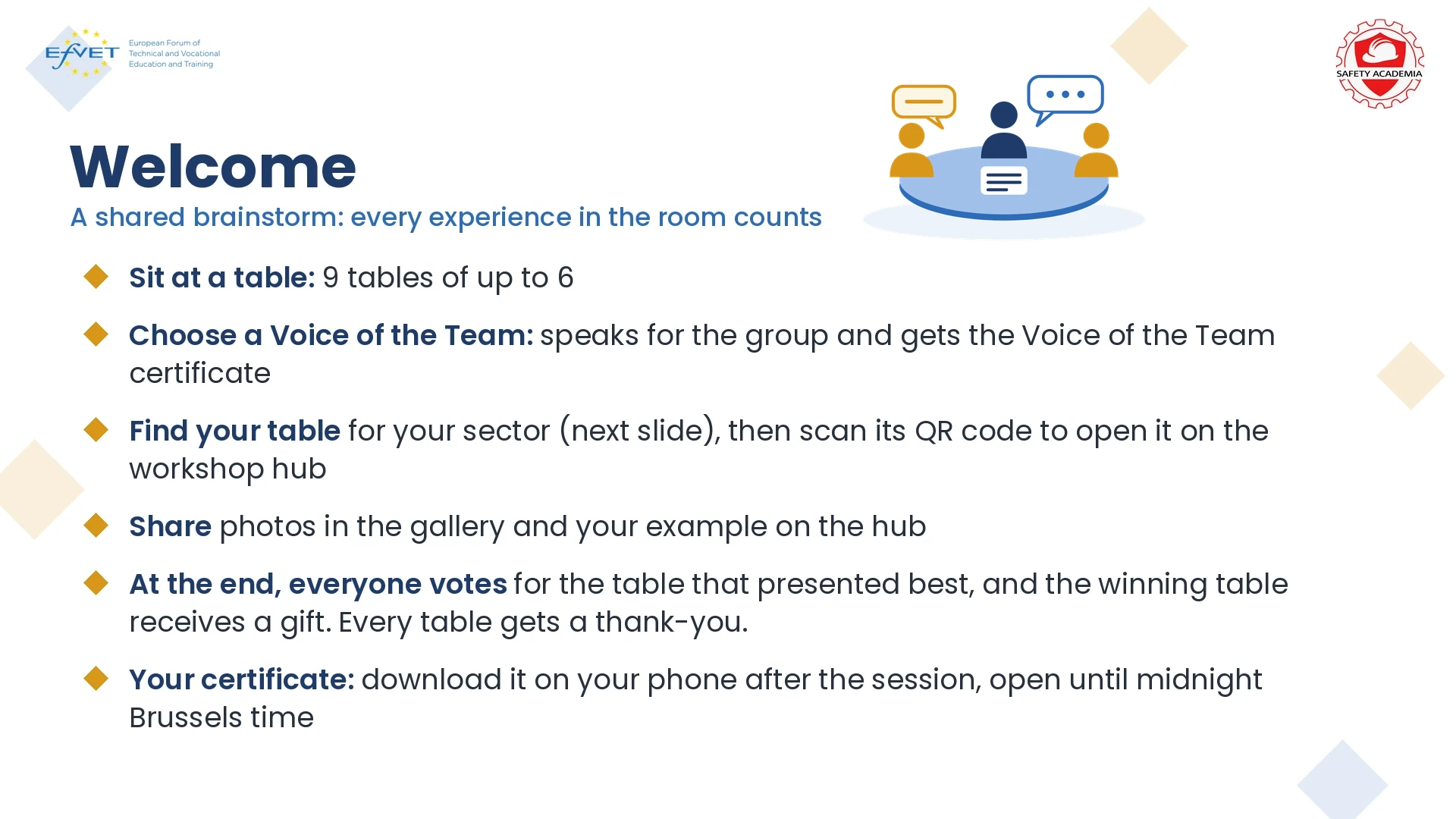
Slide 2: Welcome. A shared brainstorm: every experience in the room counts. Sit at a table: 9 tables of up to 6. Choose a Voice of the Team, who speaks for the group and gets the Voice of the Team certificate. Find your table for your sector (next slide), then scan its QR code to open it on the workshop hub. Share photos in the gallery and your example on the hub. At the end, everyone votes for the table that presented best, and the winning table receives a gift. Every table gets a thank-you. Your certificate: download it on your phone after the session, open until midnight Brussels time.
Welcome: a shared brainstorm. Sit at a table, choose a Voice of the Team, find your table and scan its QR code, share photos and examples, download your certificate.
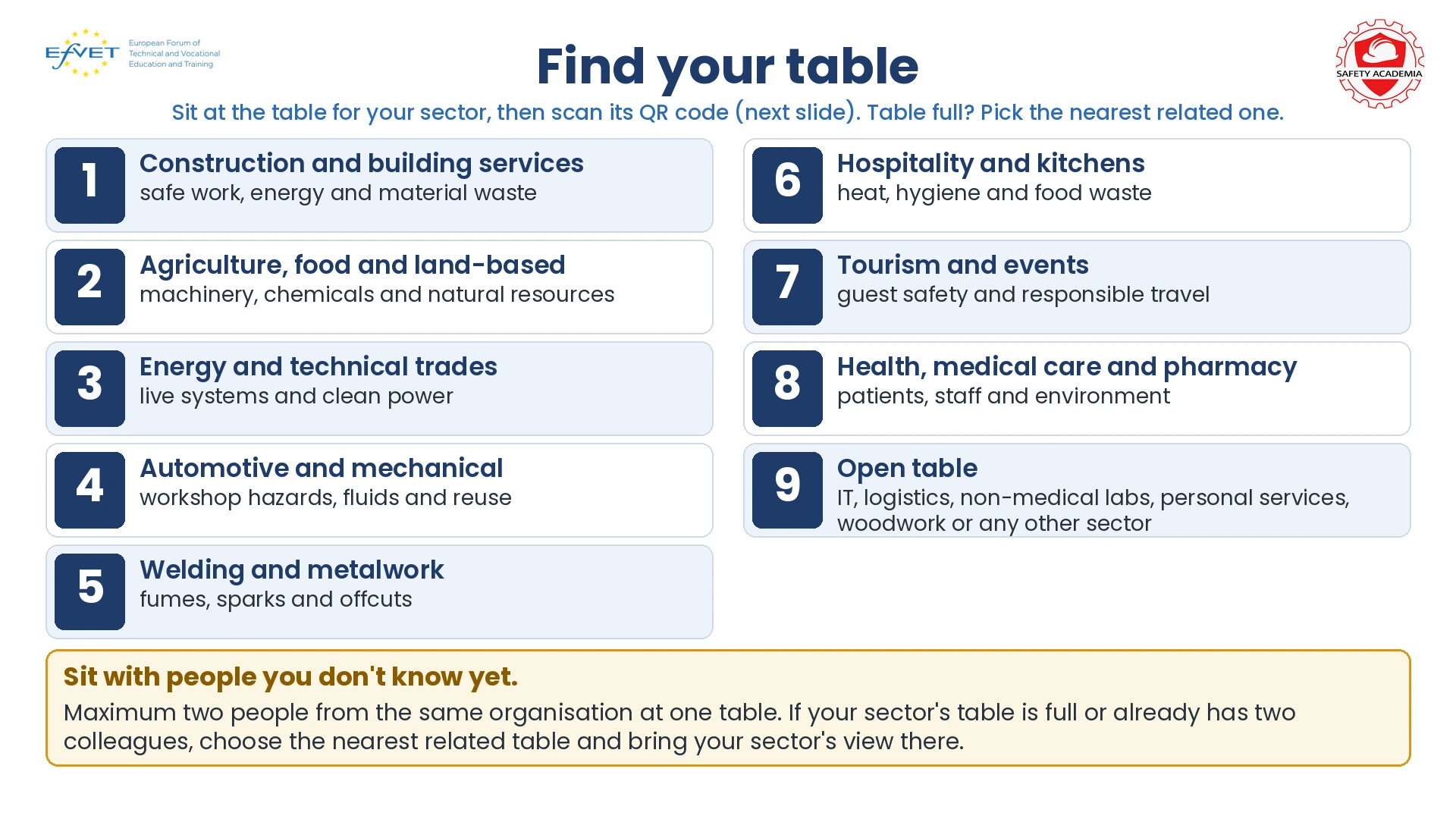
Slide 3: Find your table. Table 1 Construction and building services; Table 2 Agriculture, food and land-based; Table 3 Energy and technical trades; Table 4 Automotive and mechanical; Table 5 Welding and metalwork; Table 6 Hospitality and kitchens; Table 7 Tourism and events; Table 8 Health, medical care and pharmacy; Table 9 Open table. Sit with people you don't know yet: maximum two people from the same organisation at one table; if your sector's table is full or already has two colleagues, choose the nearest related table.
Find your table: sit at the table for your sector, then scan its QR code on the next slide. Sit with people you don't know yet.
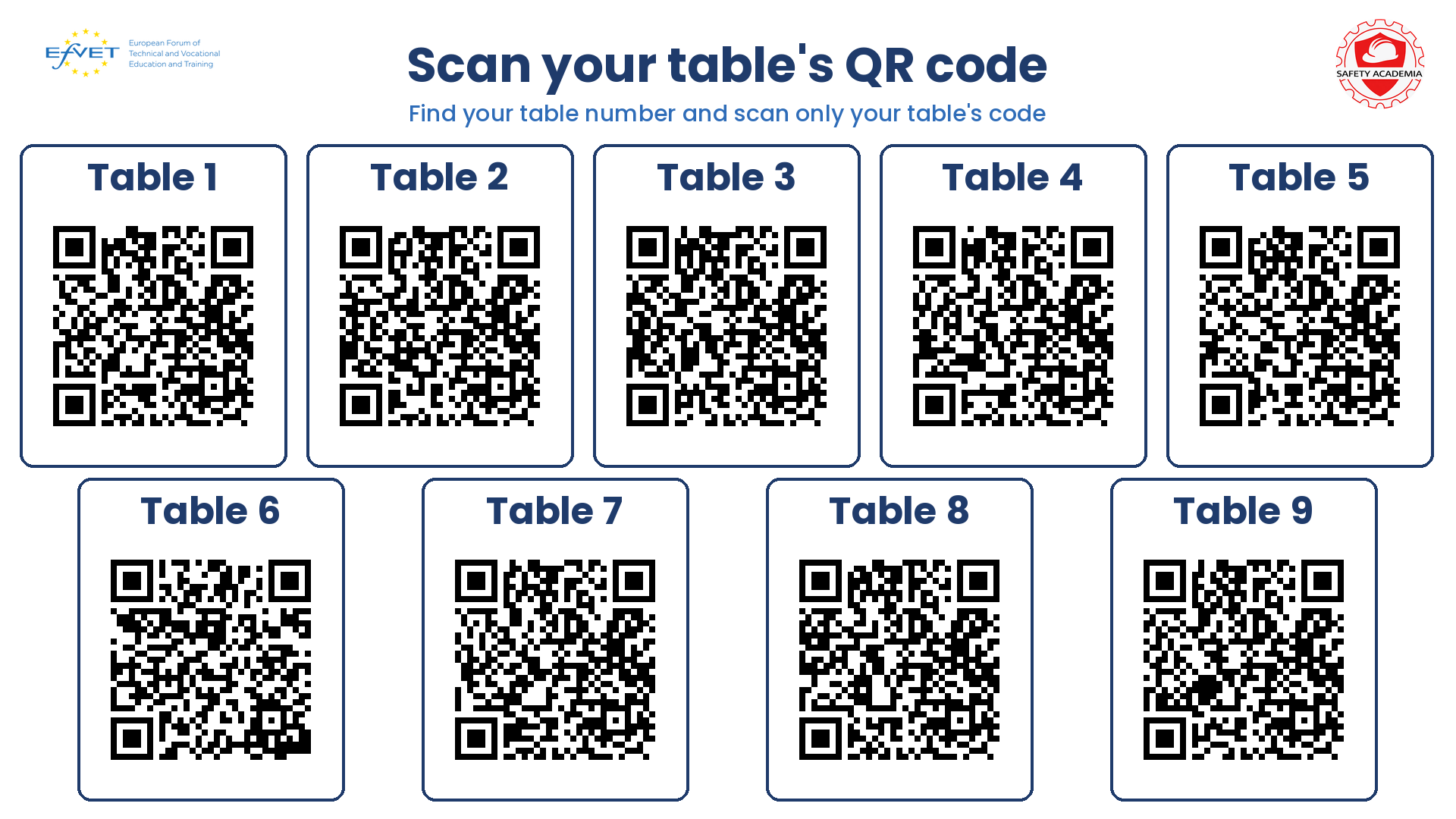
Slide 4: Scan your table's QR code. Nine QR codes, Table 1 to Table 9. Each opens that table's page on the workshop hub.
Scan your table's QR code: find your table number and scan only your table's code. Tap a code to show it full screen.
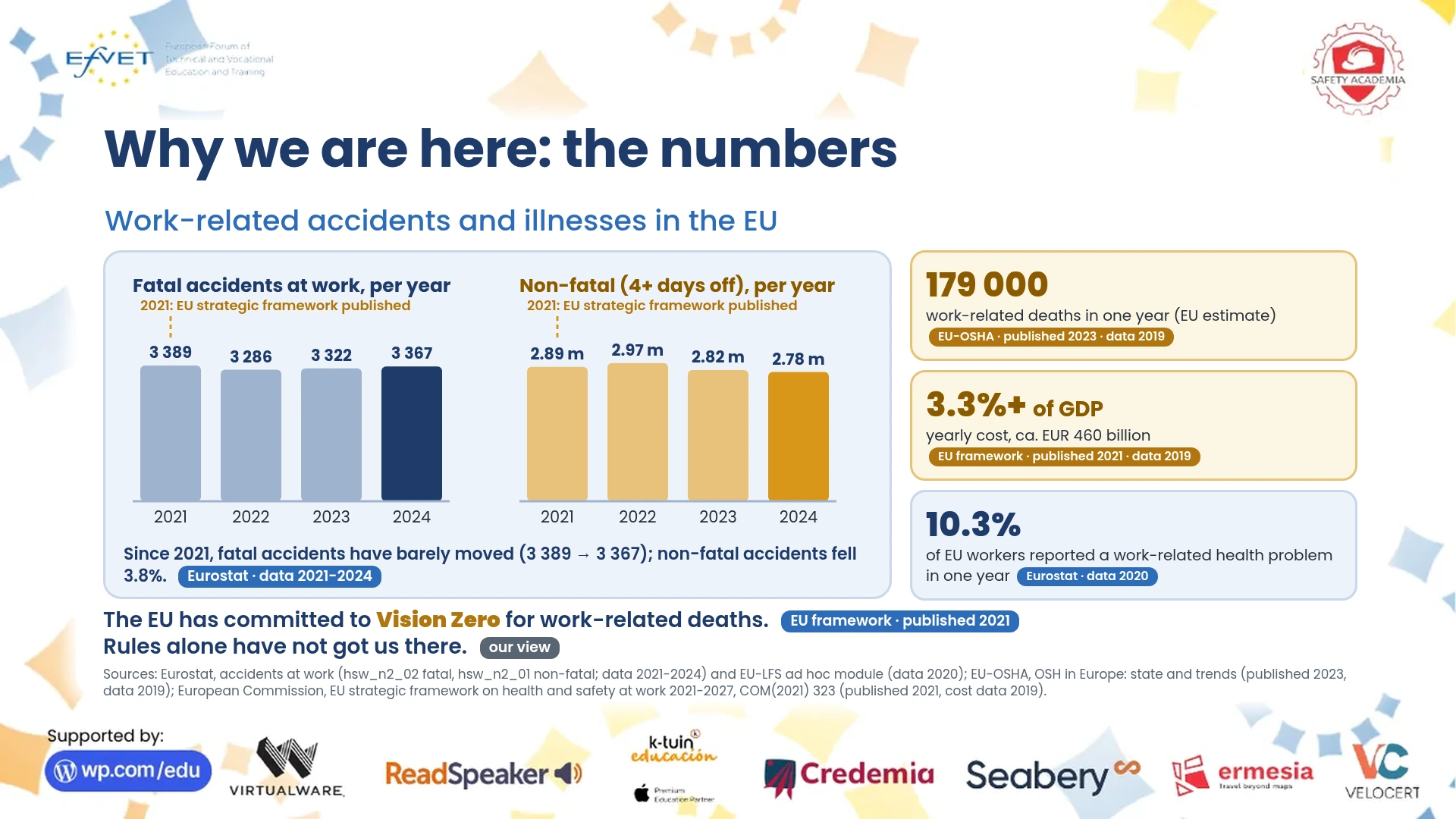
Slide 5: Why we are here: the numbers. Work-related accidents and illnesses in the EU. Bar chart, fatal accidents at work per year, EU: 2021 3 389, 2022 3 286, 2023 3 322, 2024 3 367. Bar chart, non-fatal accidents with 4 or more days off work per year, EU: 2021 2.89 million, 2022 2.97 million, 2023 2.82 million, 2024 2.78 million. Marker: 2021, EU strategic framework published. Since 2021, fatal accidents have barely moved (3 389 to 3 367); non-fatal accidents fell 3.8% (Eurostat, data 2021-2024). 179 000 work-related deaths in one year, EU estimate (EU-OSHA, published 2023, data 2019). Over 3.3% of GDP: yearly cost, ca. EUR 460 billion (EU framework, published 2021, data 2019). 10.3% of EU workers reported a work-related health problem in one year (Eurostat, data 2020). The EU has committed to Vision Zero for work-related deaths (EU framework, published 2021). Rules alone have not got us there (our view). Sources: Eurostat, accidents at work (hsw_n2_02 fatal, hsw_n2_01 non-fatal; data 2021-2024) and EU-LFS ad hoc module (data 2020); EU-OSHA, OSH in Europe: state and trends (published 2023, data 2019); European Commission, EU strategic framework on health and safety at work 2021-2027, COM(2021) 323 (published 2021, cost data 2019).
Why we are here: the numbers. EU figures from Eurostat and the EU strategic framework on health and safety at work, each with its source.
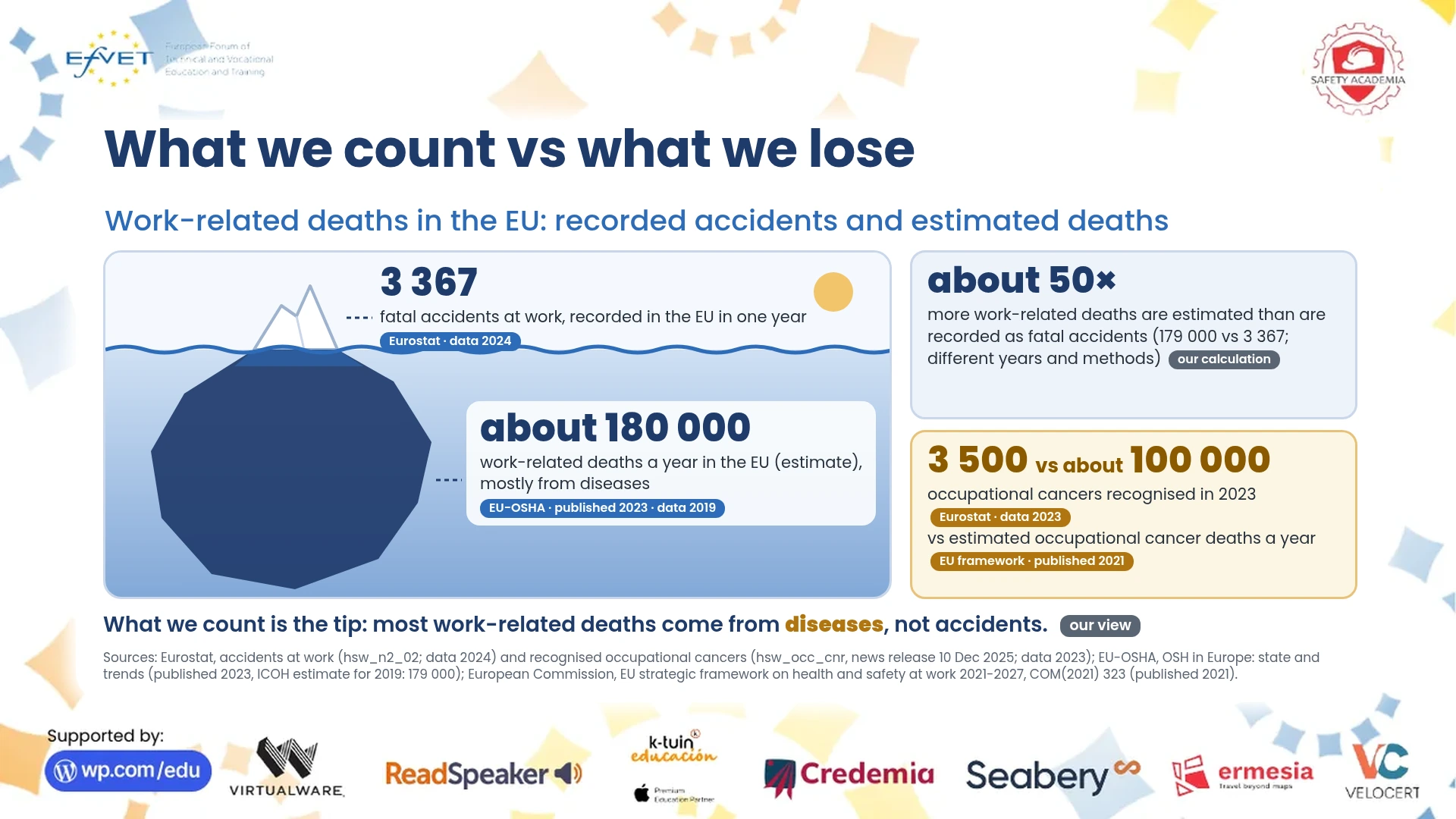
Slide 6: What we count vs what we lose. Work-related deaths in the EU: recorded accidents and estimated deaths. Illustration: an iceberg. Above the water: 3 367 fatal accidents at work, recorded in the EU in one year (Eurostat, data 2024). Below the water: about 180 000 work-related deaths a year in the EU (estimate), mostly from diseases (EU-OSHA, published 2023, data 2019). About 50 times: more work-related deaths are estimated than are recorded as fatal accidents (179 000 vs 3 367; different years and methods; our calculation). 3 500 vs about 100 000: occupational cancers recognised in 2023 (Eurostat, data 2023) vs estimated occupational cancer deaths a year (EU framework, published 2021). What we count is the tip: most work-related deaths come from diseases, not accidents (our view). Sources: Eurostat, accidents at work (hsw_n2_02; data 2024) and recognised occupational cancers (hsw_occ_cnr, news release 10 Dec 2025; data 2023); EU-OSHA, OSH in Europe: state and trends (published 2023, ICOH estimate for 2019: 179 000); European Commission, EU strategic framework on health and safety at work 2021-2027, COM(2021) 323 (published 2021).
What we count vs what we lose: 3 367 recorded fatal accidents at work against about 180 000 estimated work-related deaths a year in the EU, mostly from diseases, each with its source.
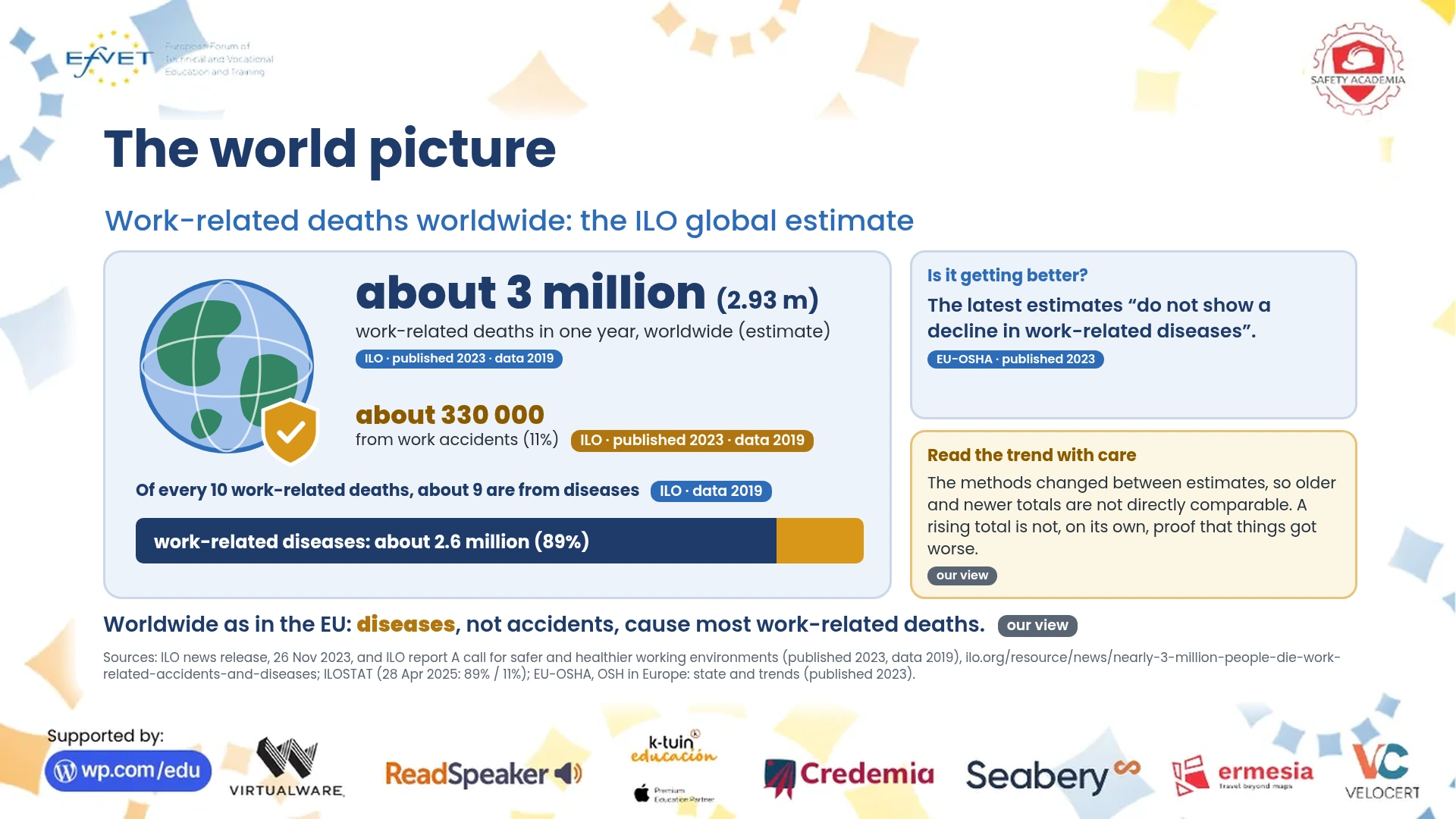
Slide 7: The world picture. Work-related deaths worldwide: the ILO global estimate. Illustration: a globe with a safety shield. About 3 million (2.93 million) work-related deaths in one year, worldwide, estimate (ILO, published 2023, data 2019). About 330 000 from work accidents, 11% (ILO, published 2023, data 2019). Of every 10 work-related deaths, about 9 are from diseases: work-related diseases about 2.6 million, 89% (ILO, data 2019). Is it getting better? The latest estimates "do not show a decline in work-related diseases" (EU-OSHA, published 2023). Read the trend with care: the methods changed between estimates, so older and newer totals are not directly comparable. A rising total is not, on its own, proof that things got worse (our view). Worldwide as in the EU: diseases, not accidents, cause most work-related deaths (our view). Sources: ILO news release, 26 Nov 2023, and ILO report A call for safer and healthier working environments (published 2023, data 2019); ILOSTAT (28 Apr 2025: 89% / 11%); EU-OSHA, OSH in Europe: state and trends (published 2023).
The world picture: about 3 million work-related deaths a year worldwide, about 2.6 million from diseases and 330 000 from accidents (ILO, data 2019). The estimates do not show a decline.
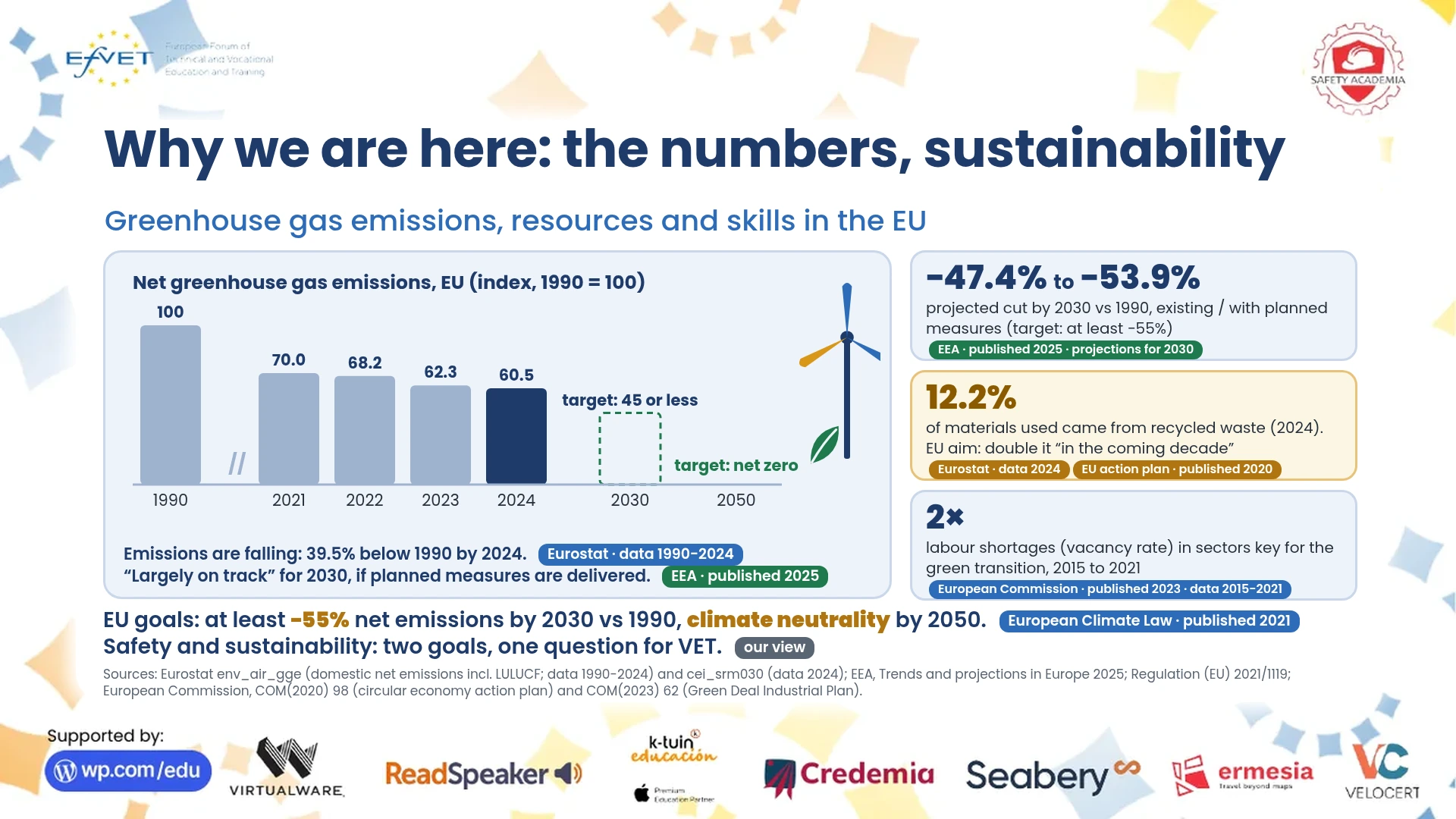
Slide 8: Why we are here: the numbers, sustainability. Greenhouse gas emissions, resources and skills in the EU. Bar chart, net greenhouse gas emissions, EU, index 1990 = 100: 1990 100, 2021 70.0, 2022 68.2, 2023 62.3, 2024 60.5; 2030 target 45 or less; 2050 target net zero. Emissions are falling: 39.5% below 1990 by 2024 (Eurostat, data 1990-2024). "Largely on track" for 2030, if planned measures are delivered (EEA, published 2025). Minus 47.4% to minus 53.9%: projected cut by 2030 vs 1990, existing / with planned measures; target at least minus 55% (EEA, published 2025, projections for 2030). 12.2% of materials used came from recycled waste (2024); EU aim: double it "in the coming decade" (Eurostat, data 2024; EU action plan, published 2020). 2 times: labour shortages (vacancy rate) in sectors key for the green transition, 2015 to 2021 (European Commission, published 2023, data 2015-2021). EU goals: at least minus 55% net emissions by 2030 vs 1990, climate neutrality by 2050 (European Climate Law, published 2021). Safety and sustainability: two goals, one question for VET (our view). Illustration: a wind turbine and a leaf.
Why we are here: the numbers, sustainability. EU greenhouse gas emissions against the 2030 and 2050 goals, circular material use and green-skills shortages, each with its source.
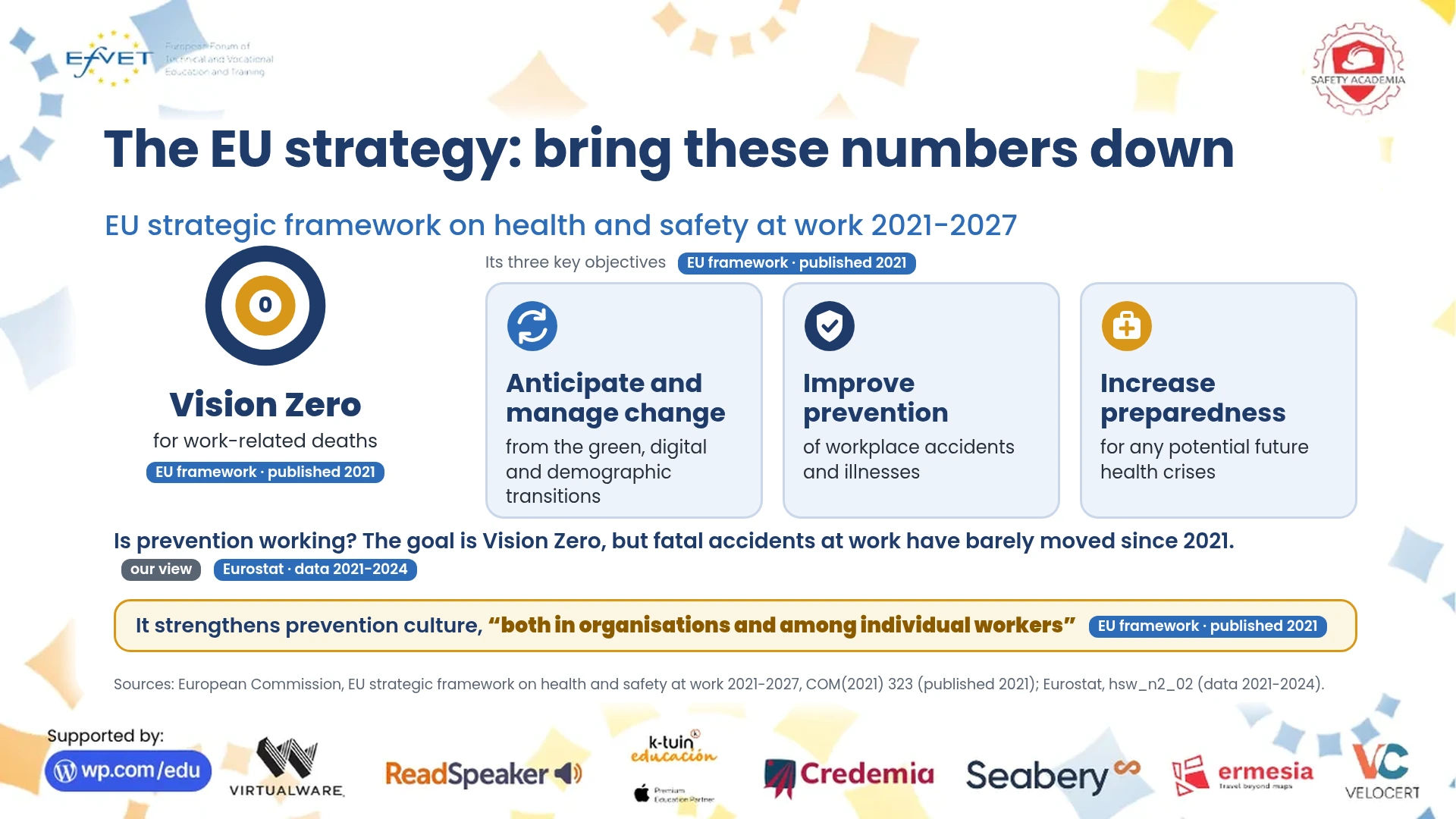
Slide 9: The EU strategy: bring these numbers down. EU strategic framework on health and safety at work 2021-2027. Vision Zero for work-related deaths. Its three key objectives: anticipate and manage change from the green, digital and demographic transitions; improve prevention of workplace accidents and illnesses; increase preparedness for any potential future health crises. Is prevention working? The goal is Vision Zero, but fatal accidents at work have barely moved since 2021 (our view; Eurostat, data 2021-2024). It strengthens prevention culture, "both in organisations and among individual workers". Sources: European Commission, EU strategic framework on health and safety at work 2021-2027, COM(2021) 323; Eurostat, fatal accidents at work (hsw_n2_02; data 2021-2024).
The EU strategy: Vision Zero, three key objectives and prevention culture.
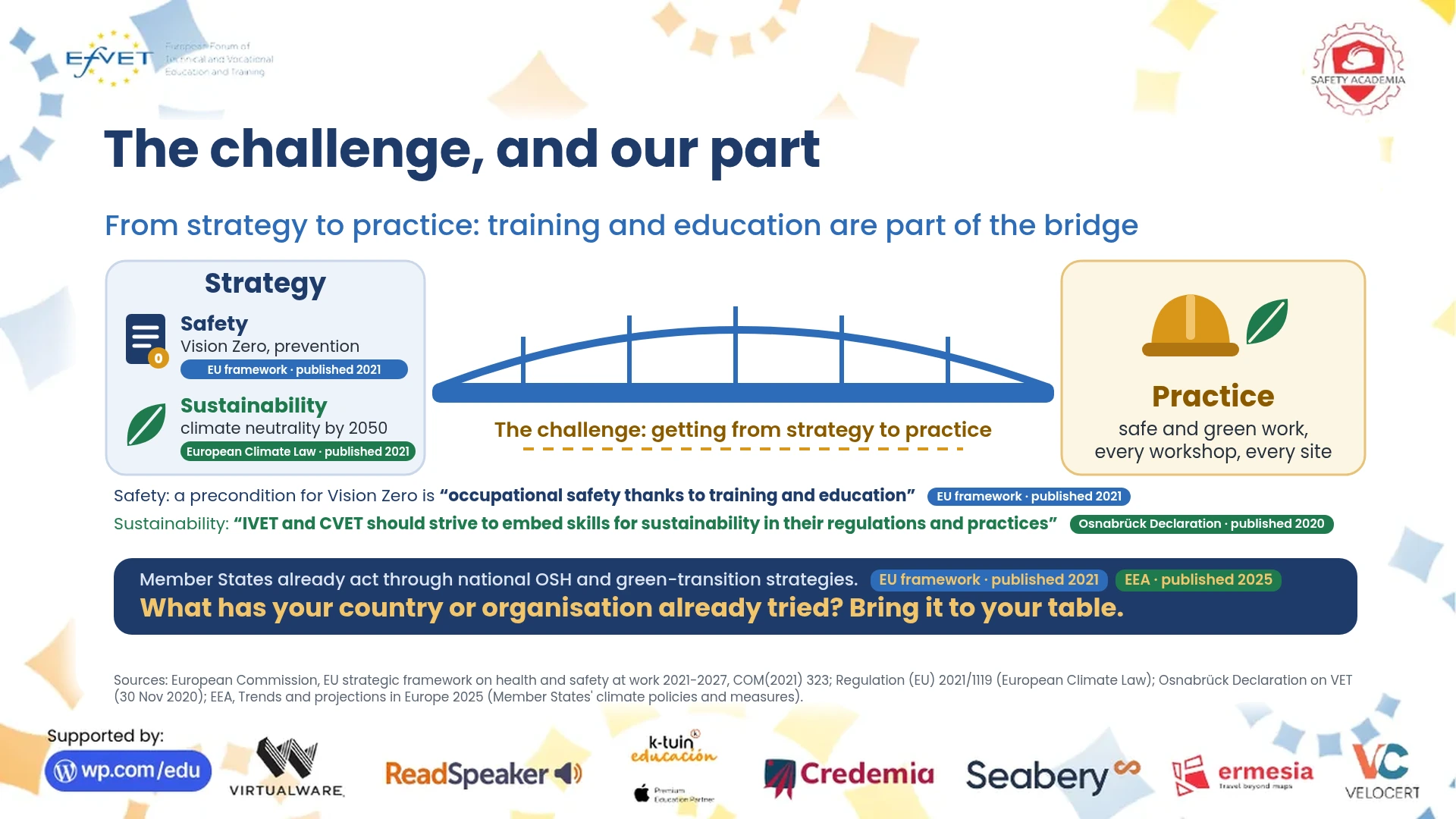
Slide 10: The challenge, and our part. From strategy to practice: training and education are part of the bridge. A bridge from Strategy to Practice. Strategy: Safety, Vision Zero, prevention (EU framework, published 2021); Sustainability, climate neutrality by 2050 (European Climate Law, published 2021). Practice: safe and green work, every workshop, every site (helmet and leaf). The challenge: getting from strategy to practice. Safety: a precondition for Vision Zero is "occupational safety thanks to training and education" (EU framework, published 2021). Sustainability: "IVET and CVET should strive to embed skills for sustainability in their regulations and practices" (Osnabrück Declaration, published 2020). Member States already act through national OSH and green-transition strategies (EU framework, published 2021; EEA, published 2025). What has your country or organisation already tried? Bring it to your table.
The challenge, and our part: from safety and sustainability strategy to safe and green practice. What has your country or organisation already tried? Bring it to your table.
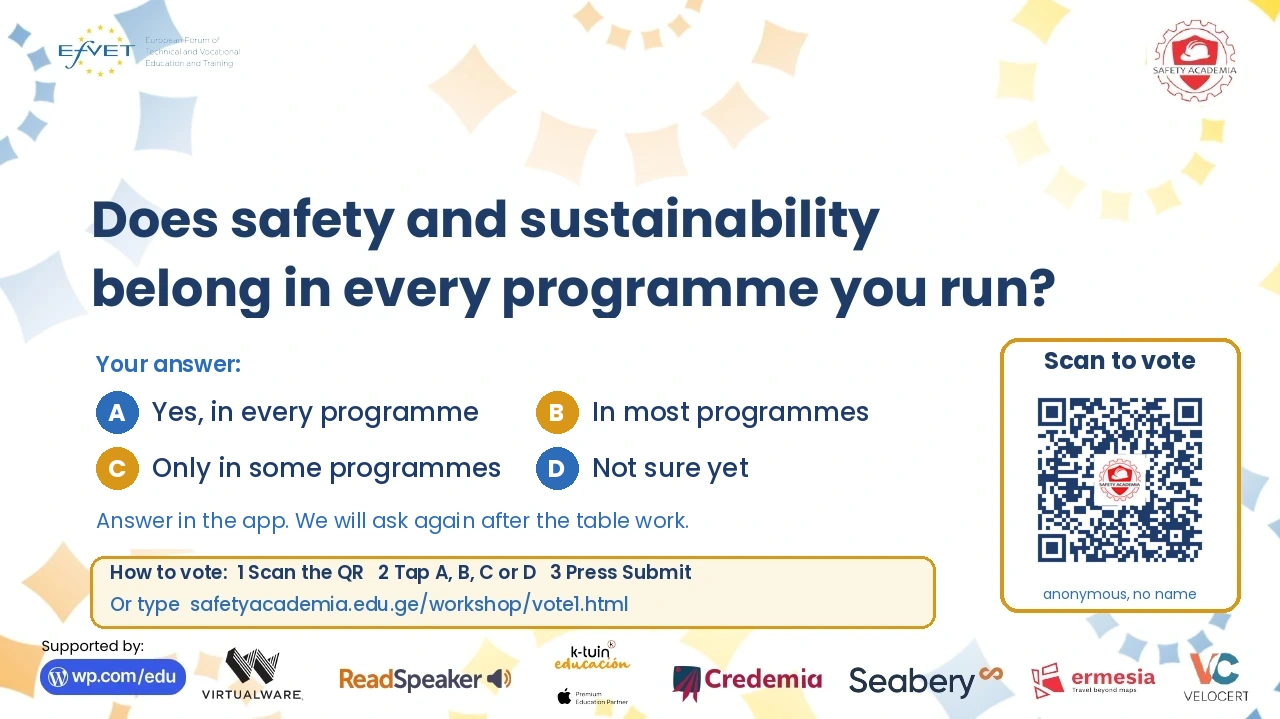
Slide 11: The opening question for the room: Does safety and sustainability belong in every programme you run? Your answer: A Yes, in every programme. B In most programmes. C Only in some programmes. D Not sure yet. Answer in the app; we will ask again after the table work. Scan to vote (QR 1), or type safetyacademia.edu.ge/workshop/vote1.html. Anonymous, no name.
The opening question for the room. Answer in the app; we will ask again after the table work.
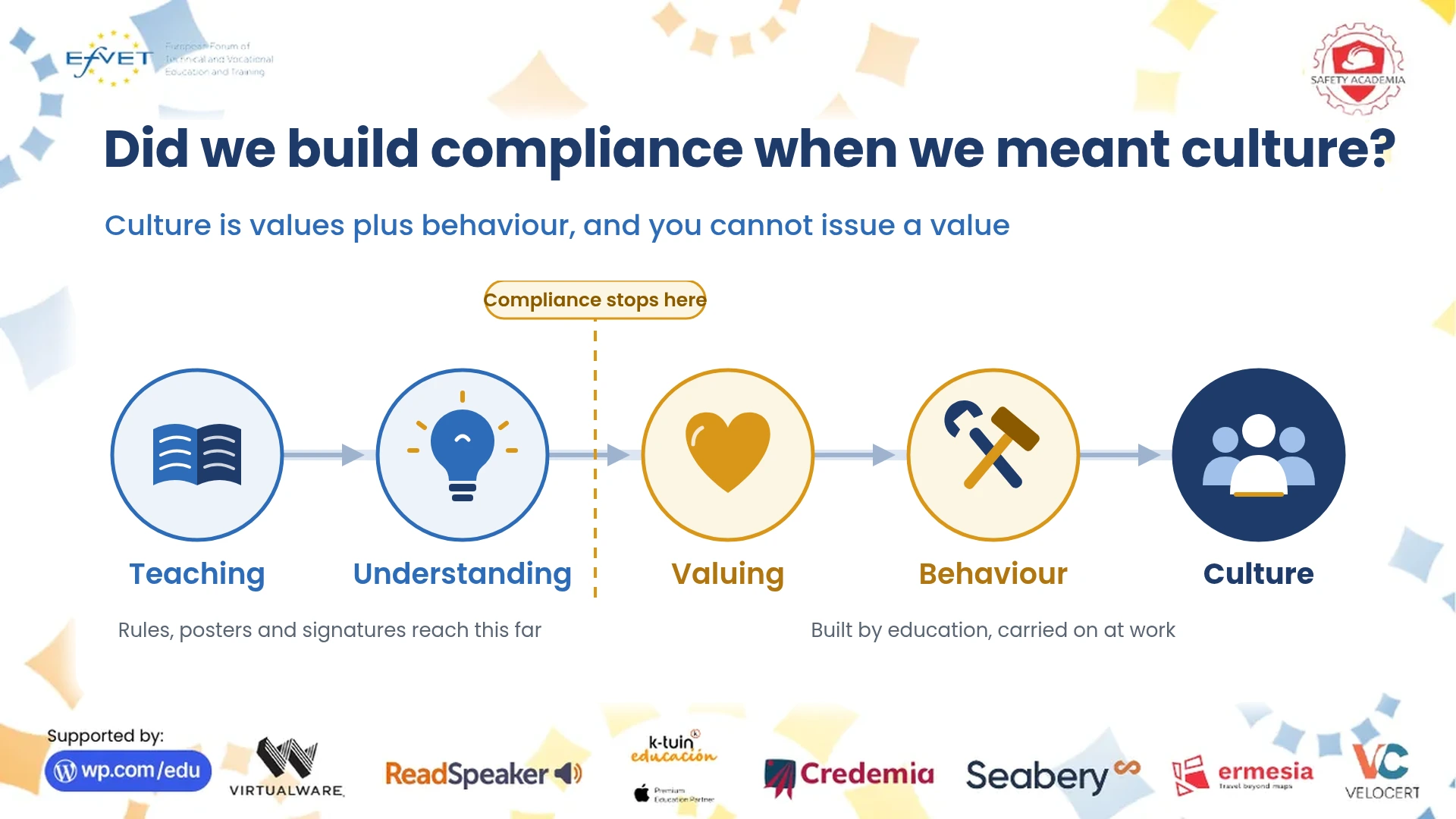
Slide 12: Did we build compliance when we meant culture? Culture is values plus behaviour, and you cannot issue a value. Teaching, Understanding, then the marker Compliance stops here, then Valuing, Behaviour, Culture. Rules, posters and signatures reach this far; built by education, carried on at work.
Did we build compliance when we meant culture? Teaching, understanding, valuing, behaviour, culture: compliance stops before valuing.
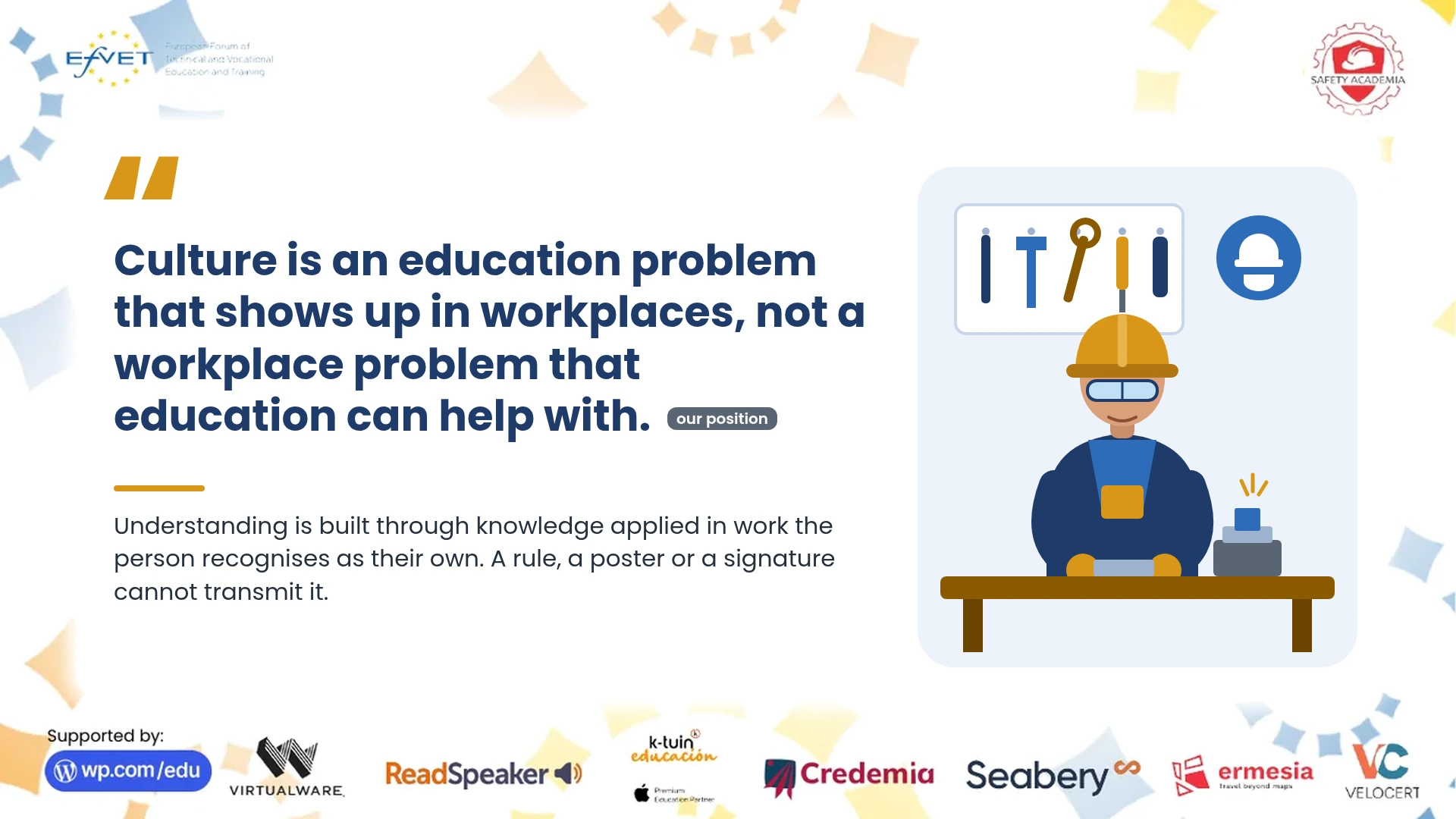
Slide 13: Culture is an education problem that shows up in workplaces, not a workplace problem that education can help with (our position). Understanding is built through knowledge applied in work the person recognises as their own. A rule, a poster or a signature cannot transmit it. Illustration of a learner in a vocational workshop.
Culture is an education problem that shows up in workplaces, not a workplace problem that education can help with.
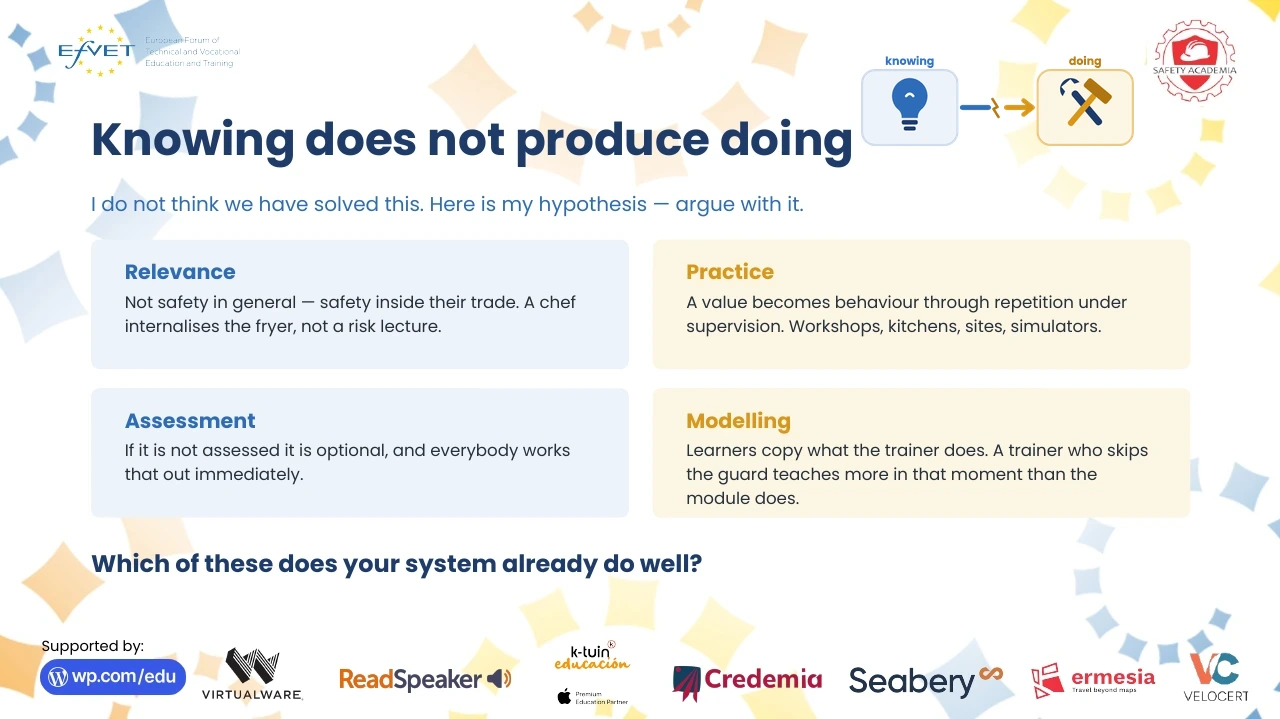
Slide 14: Knowing does not produce doing: a hypothesis to argue with. Which of these does your system already do well?
Knowing does not produce doing: a hypothesis to argue with. Which of these does your system already do well?
Slide 15: Table challenge. Table challenge starts now. 35 minutes, at your table. Voice of the Team writes, everyone contributes.
Table challenge starts now: 35 minutes at your table. Voice of the Team writes, everyone contributes.
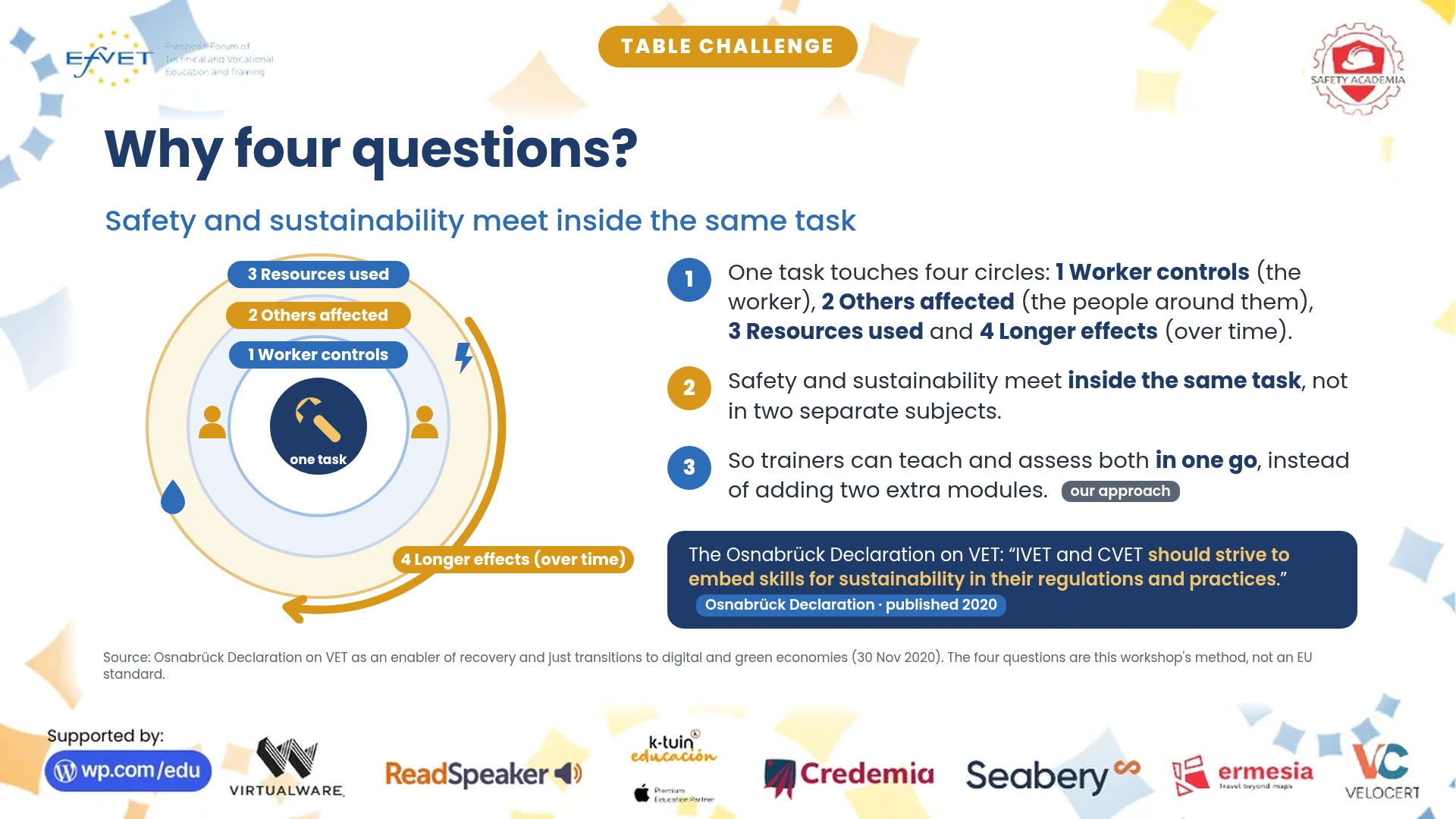
Slide 16: Table challenge. Why four questions? Safety and sustainability meet inside the same task. Illustration: four circles around one task: 1 Worker controls, 2 Others affected, 3 Resources used, and a bold arrow around the outer ring, 4 Longer effects (over time). One task touches four circles: 1 Worker controls (the worker), 2 Others affected (the people around them), 3 Resources used and 4 Longer effects (over time). Safety and sustainability meet inside the same task, not in two separate subjects. So trainers can teach and assess both in one go, instead of adding two extra modules (our approach). The Osnabrück Declaration on VET: "IVET and CVET should strive to embed skills for sustainability in their regulations and practices." (Osnabrück Declaration, published 2020). Source: Osnabrück Declaration on VET as an enabler of recovery and just transitions to digital and green economies (30 Nov 2020). The four questions are this workshop's method, not an EU standard.
Why four questions? One task touches four circles: the worker, the people around them, the resources it uses and its effects over time. Safety and sustainability meet inside the same task.
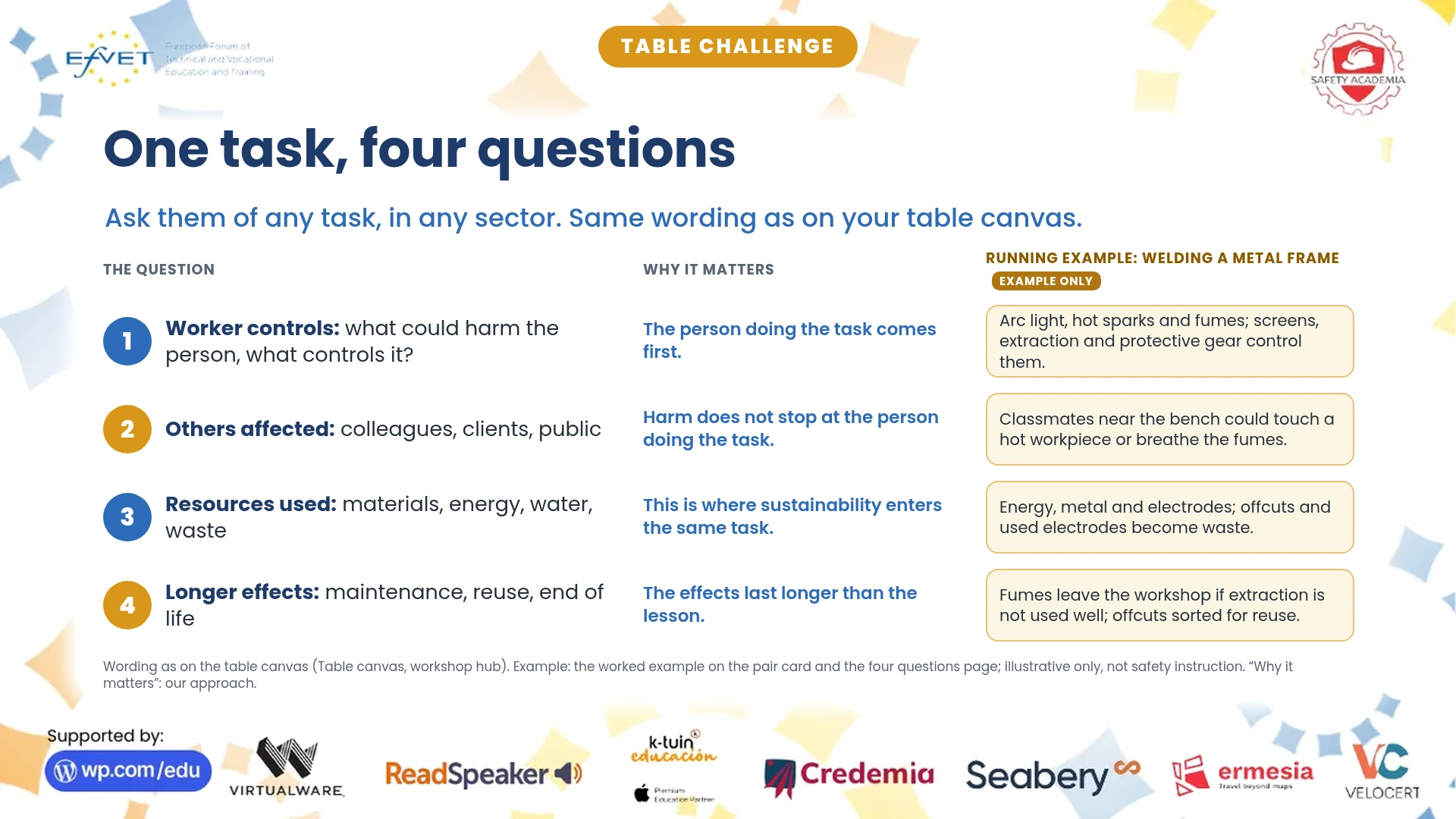
Slide 17: Table challenge. One task, four questions. Ask them of any task, in any sector. Same wording as on your table canvas. Columns: the question, why it matters, running example: welding a metal frame (example only). 1 Worker controls: what could harm the person, what controls it? Why: the person doing the task comes first. Example: arc light, hot sparks and fumes; screens, extraction and protective gear control them. 2 Others affected: colleagues, clients, public. Why: harm does not stop at the person doing the task. Example: classmates near the bench could touch a hot workpiece or breathe the fumes. 3 Resources used: materials, energy, water, waste. Why: this is where sustainability enters the same task. Example: energy, metal and electrodes; offcuts and used electrodes become waste. 4 Longer effects: maintenance, reuse, end of life. Why: the effects last longer than the lesson. Example: fumes leave the workshop if extraction is not used well; offcuts sorted for reuse.
Table challenge: one task, four questions, the same wording as on the table canvas, with why each matters and one running example (welding a metal frame).
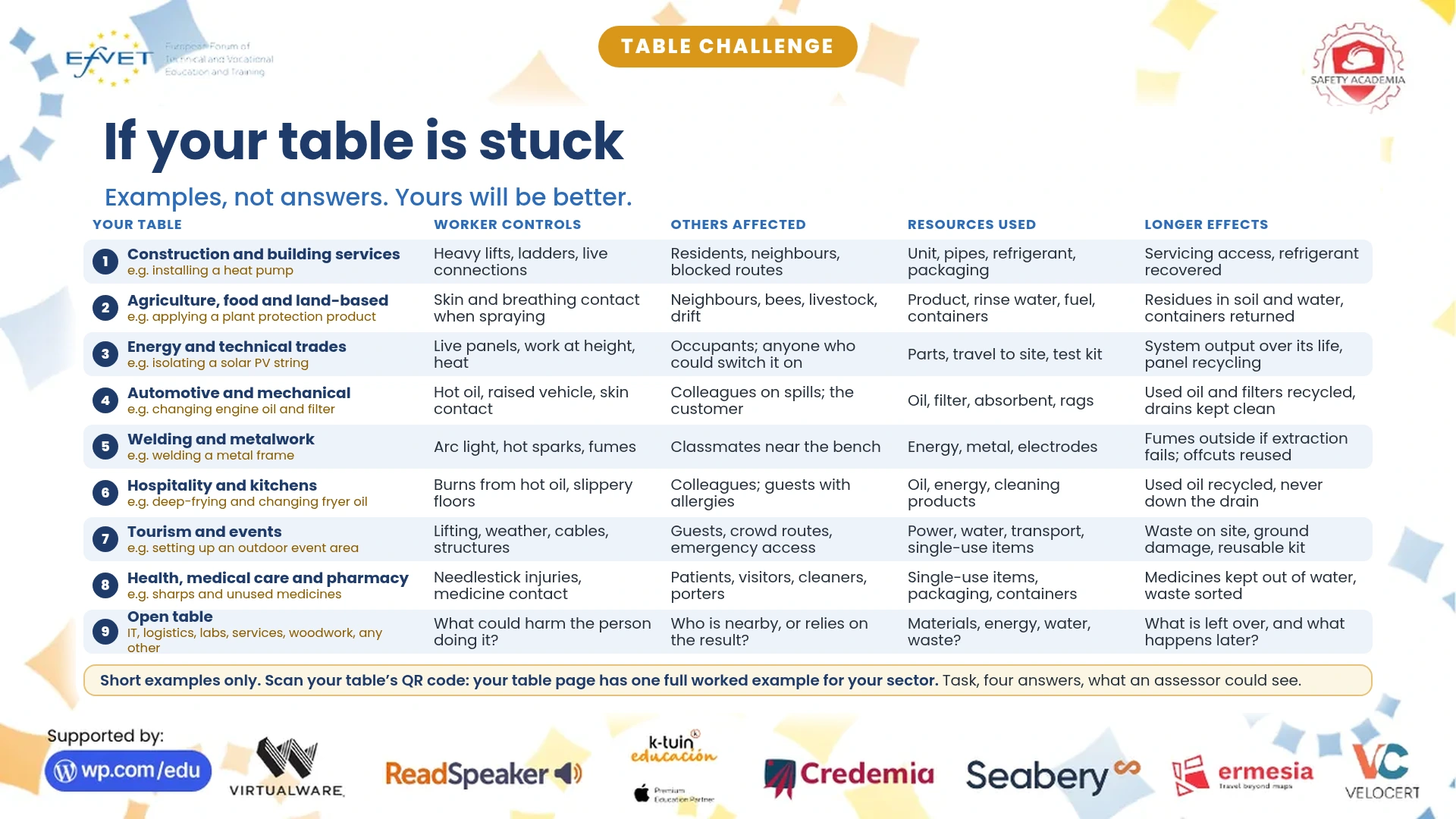
Slide 18: Table challenge. If your table is stuck. Examples, not answers. Yours will be better. One row per table, columns worker controls, others affected, resources used, longer effects. Table 1, Construction and building services (e.g. installing a heat pump): Heavy lifts, ladders, live connections; Residents, neighbours, blocked routes; Unit, pipes, refrigerant, packaging; Servicing access, refrigerant recovered. Table 2, Agriculture, food and land-based (e.g. applying a plant protection product): Skin and breathing contact when spraying; Neighbours, bees, livestock, drift; Product, rinse water, fuel, containers; Residues in soil and water, containers returned. Table 3, Energy and technical trades (e.g. isolating a solar PV string): Live panels, work at height, heat; Occupants; anyone who could switch it on; Parts, travel to site, test kit; System output over its life, panel recycling. Table 4, Automotive and mechanical (e.g. changing engine oil and filter): Hot oil, raised vehicle, skin contact; Colleagues on spills; the customer; Oil, filter, absorbent, rags; Used oil and filters recycled, drains kept clean. Table 5, Welding and metalwork (e.g. welding a metal frame): Arc light, hot sparks, fumes; Classmates near the bench; Energy, metal, electrodes; Fumes outside if extraction fails; offcuts reused. Table 6, Hospitality and kitchens (e.g. deep-frying and changing fryer oil): Burns from hot oil, slippery floors; Colleagues; guests with allergies; Oil, energy, cleaning products; Used oil recycled, never down the drain. Table 7, Tourism and events (e.g. setting up an outdoor event area): Lifting, weather, cables, structures; Guests, crowd routes, emergency access; Power, water, transport, single-use items; Waste on site, ground damage, reusable kit. Table 8, Health, medical care and pharmacy (e.g. sharps and unused medicines): Needlestick injuries, medicine contact; Patients, visitors, cleaners, porters; Single-use items, packaging, containers; Medicines kept out of water, waste sorted. Table 9, Open table (IT, logistics, labs, services, woodwork, any other: one weekly task): What could harm the person doing it?; Who is nearby, or relies on the result?; Materials, energy, water, waste?; What is left over, and what happens later?. Short examples only. Scan your table's QR code: your table page has one full worked example for your sector. Task, four answers, what an assessor could see.
If your table is stuck: short examples for all nine tables, not answers. Yours will be better. Scan your table's QR code for your table's full worked example.
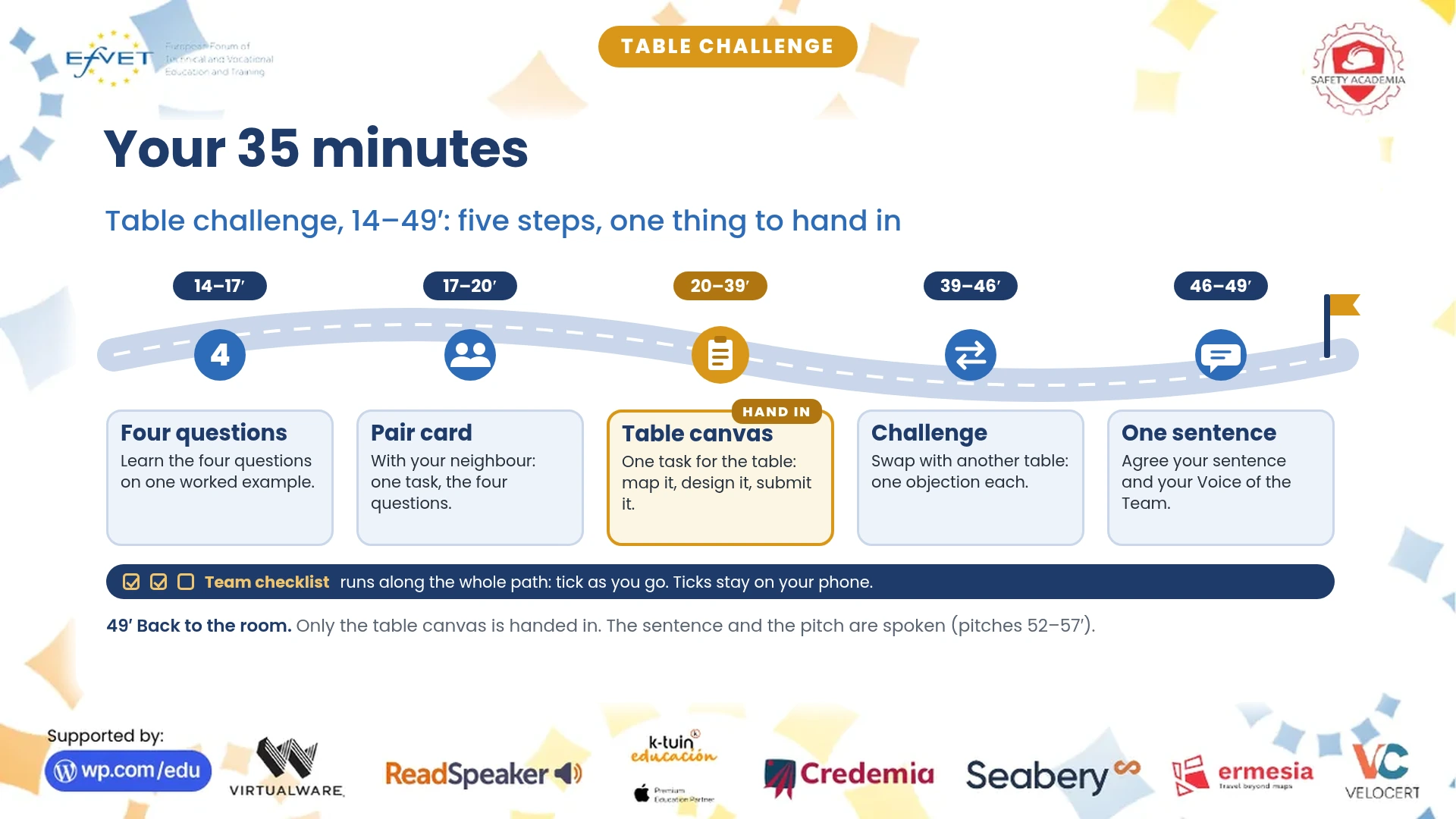
Slide 19: Table challenge. Your 35 minutes. Table challenge, 14 to 49 minutes: five steps, one thing to hand in. A road with five stops: 14 to 17 minutes, Four questions: learn the four questions on one worked example. 17 to 20, Pair card: with your neighbour, one task, the four questions. 20 to 39, Table canvas (hand in): one task for the table, map it, design it, submit it. 39 to 46, Challenge: swap with another table, one objection each. 46 to 49, One sentence: agree your sentence and your Voice of the Team. A bar along the whole road: Team checklist, tick as you go, ticks stay on your phone. 49 minutes: back to the room. Only the table canvas is handed in. The sentence and the pitch are spoken (pitches 52 to 57 minutes).
Your 35 minutes: four questions, pair card, table canvas (the one thing you hand in), challenge, one sentence, with the team checklist along the way.
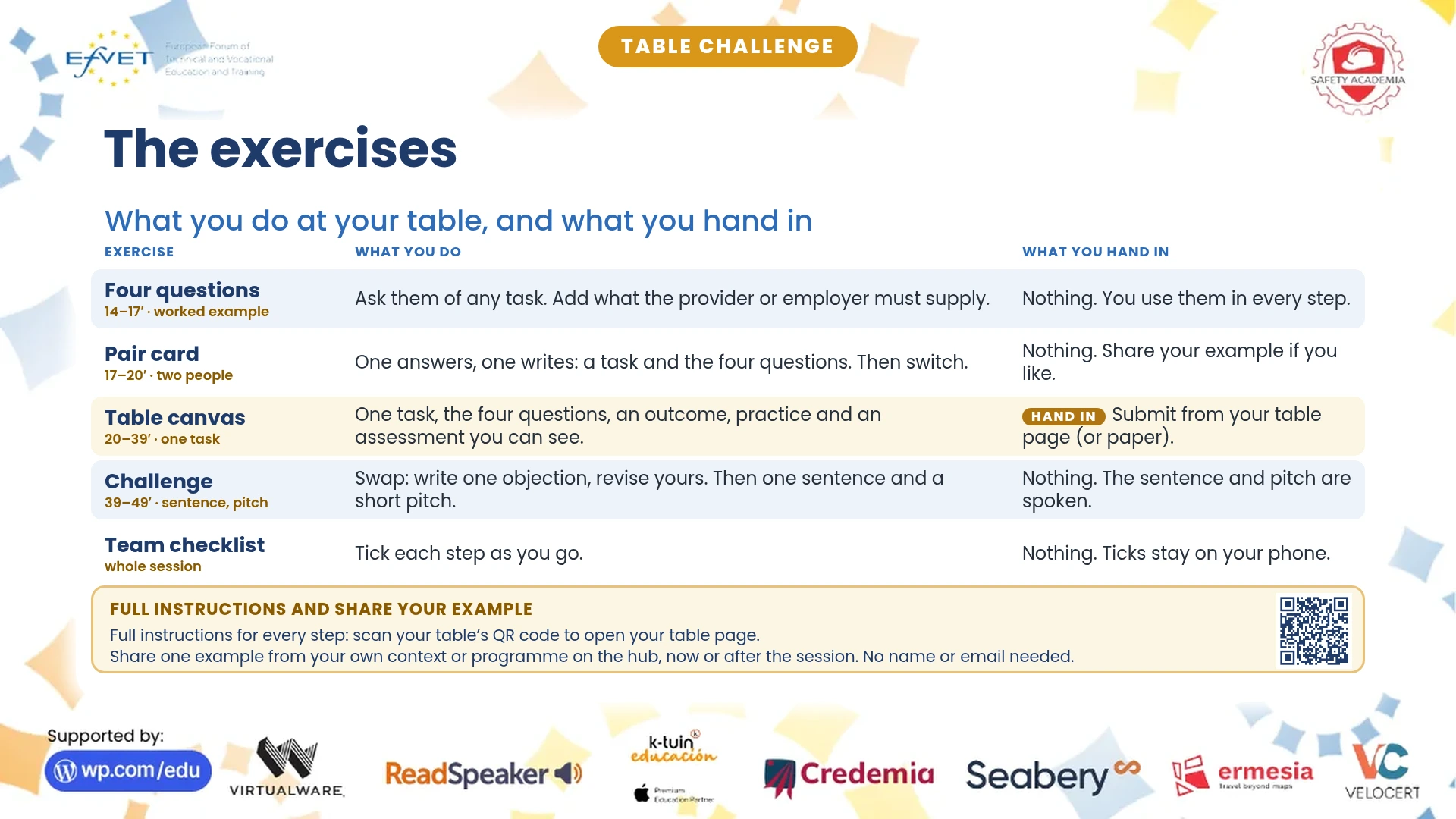
Slide 20: Table challenge. The exercises: what you do at your table, and what you hand in. Four questions (14 to 17 minutes, worked example): ask them of any task, add what the provider or employer must supply; hand in nothing, you use them in every step. Pair card (17 to 20, two people): one answers, one writes, a task and the four questions, then switch; hand in nothing, share your example if you like. Table canvas (20 to 39, one task): one task, the four questions, an outcome, practice and an assessment you can see; HAND IN: submit from your table page (or paper). Challenge (39 to 49, sentence, pitch): swap, write one objection, revise yours, then one sentence and a short pitch; hand in nothing, the sentence and pitch are spoken. Team checklist (whole session): tick each step as you go; ticks stay on your phone. Full instructions for every step: scan your table's QR code to open your table page. Share one example from your own context or programme on the hub (QR), now or after the session. No name or email needed.
The exercises: what you do at your table and what you hand in. Share your example.
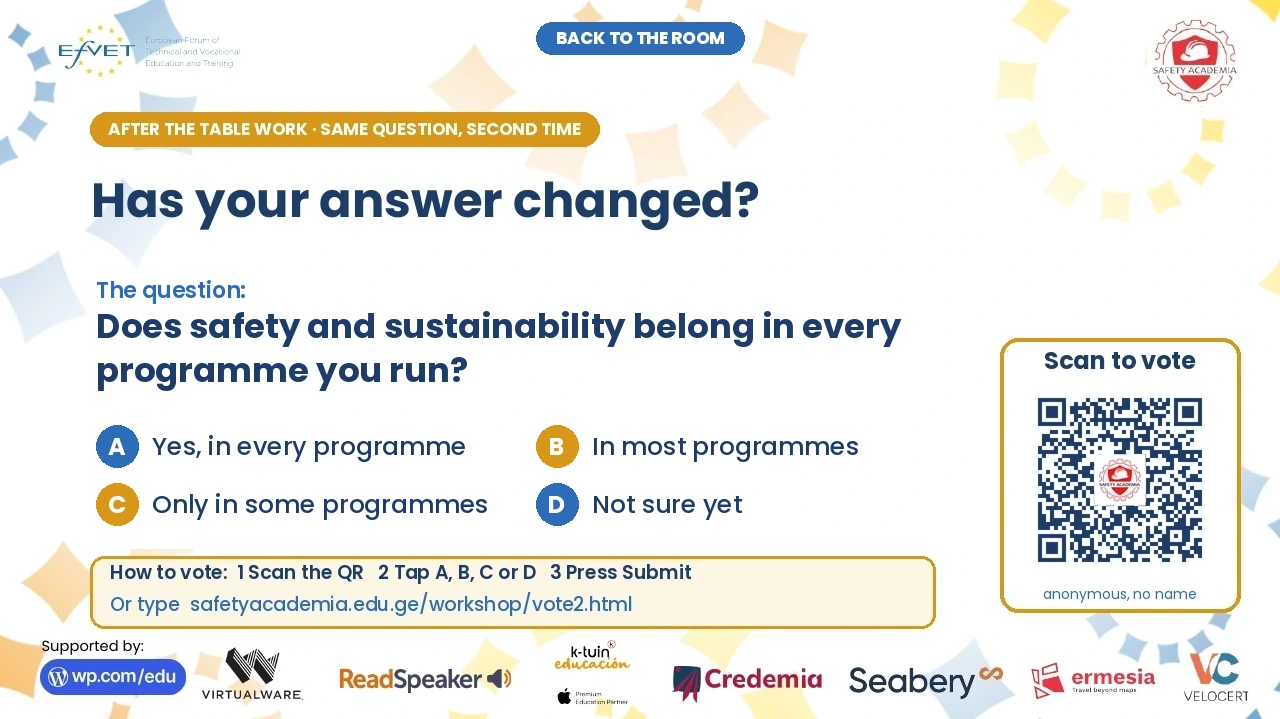
Slide 21: Back to the room. After the table work, same question, second time. Has your answer changed? The question: Does safety and sustainability belong in every programme you run? A Yes, in every programme. B In most programmes. C Only in some programmes. D Not sure yet. Scan to vote (QR 2), or type safetyacademia.edu.ge/workshop/vote2.html. Anonymous, no name.
Has your answer changed? The opening question again, after the table work.
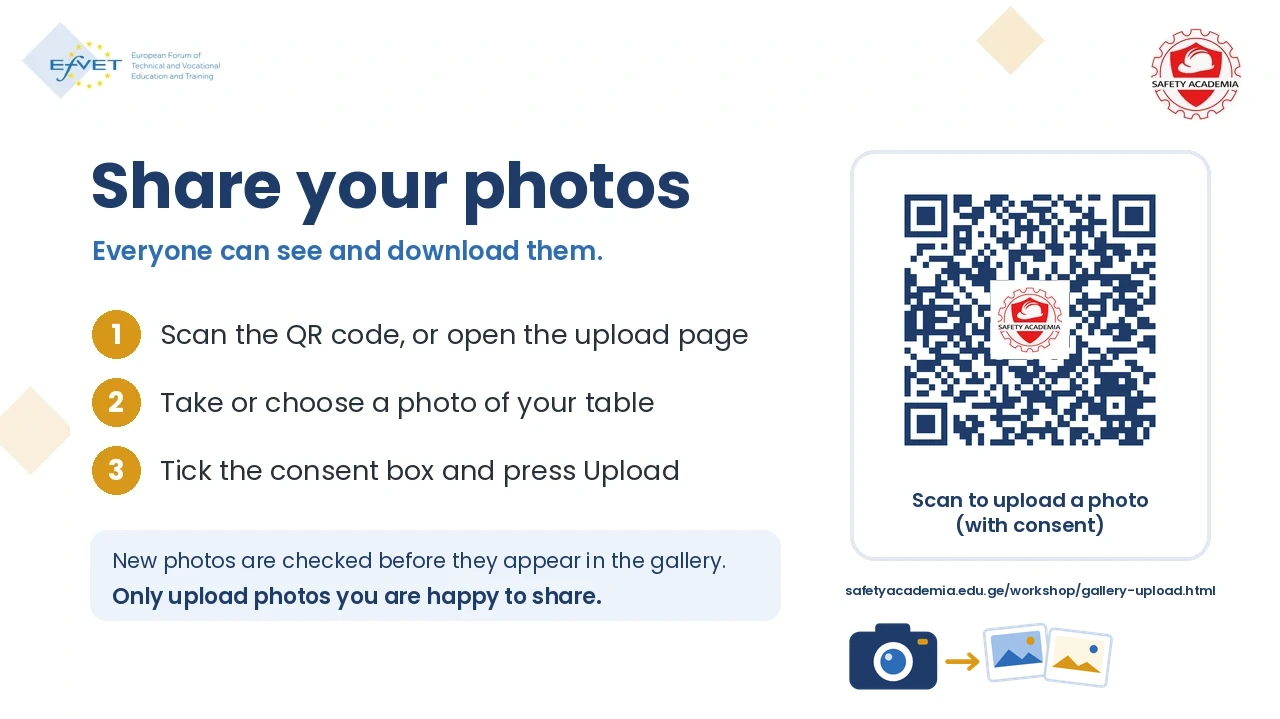
Slide 22: Share your photos. Scan the QR code, take or choose a photo of your table, tick the consent box and press Upload.
Share your photos: scan the QR code to upload a photo (with consent).
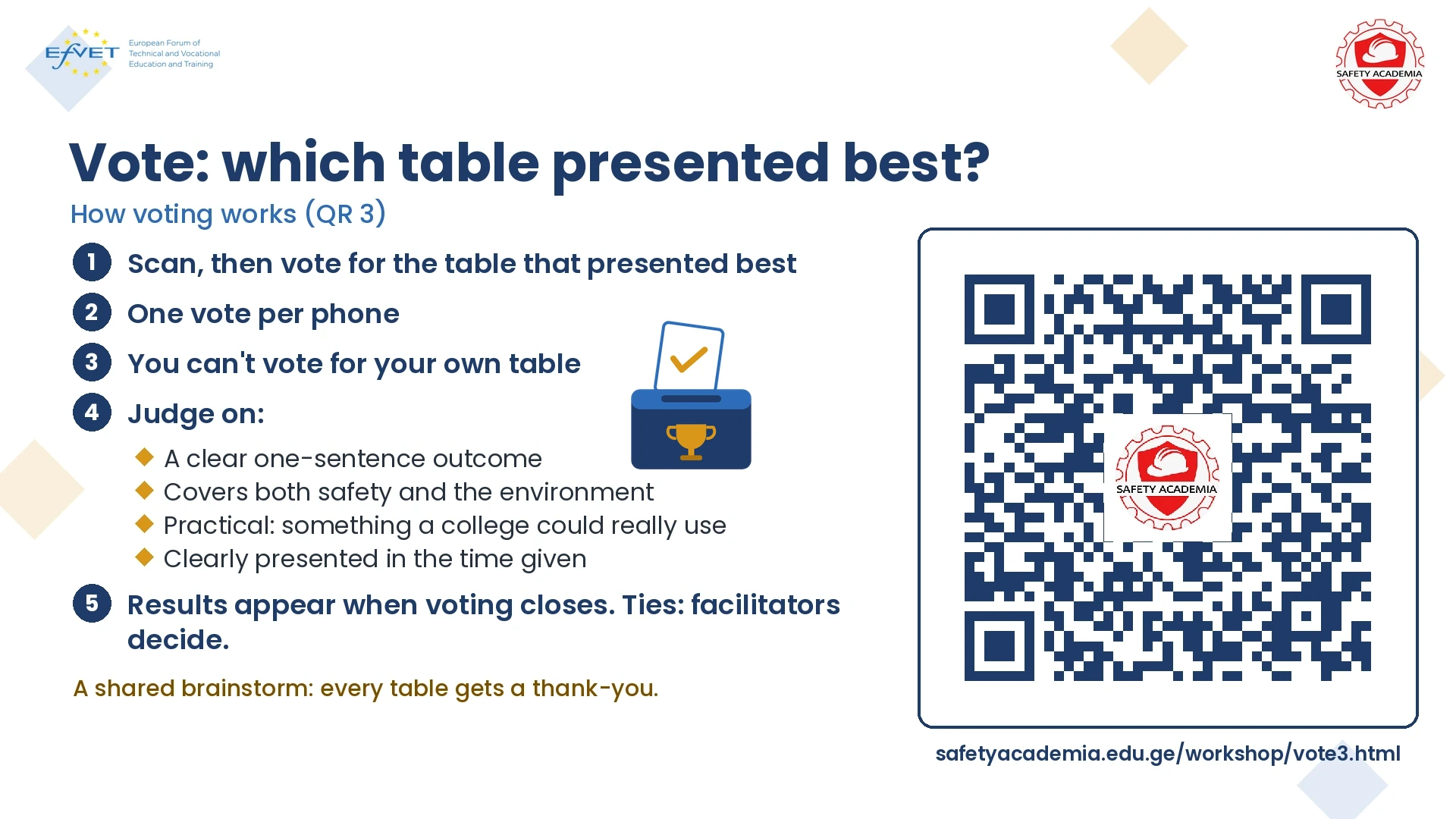
Slide 23: Vote: which table presented best? QR 3, one vote per phone, not your own table. Judge on: a clear one-sentence outcome; covers both safety and the environment; practical, something a college could really use; clearly presented in the time given. The table with the most votes receives the prize; the facilitators break ties. Every table gets a thank-you. QR code to safetyacademia.edu.ge/workshop/vote3.html
Vote: which table presented best? Scan QR 3 (not your own table). Most votes wins; facilitators break ties.
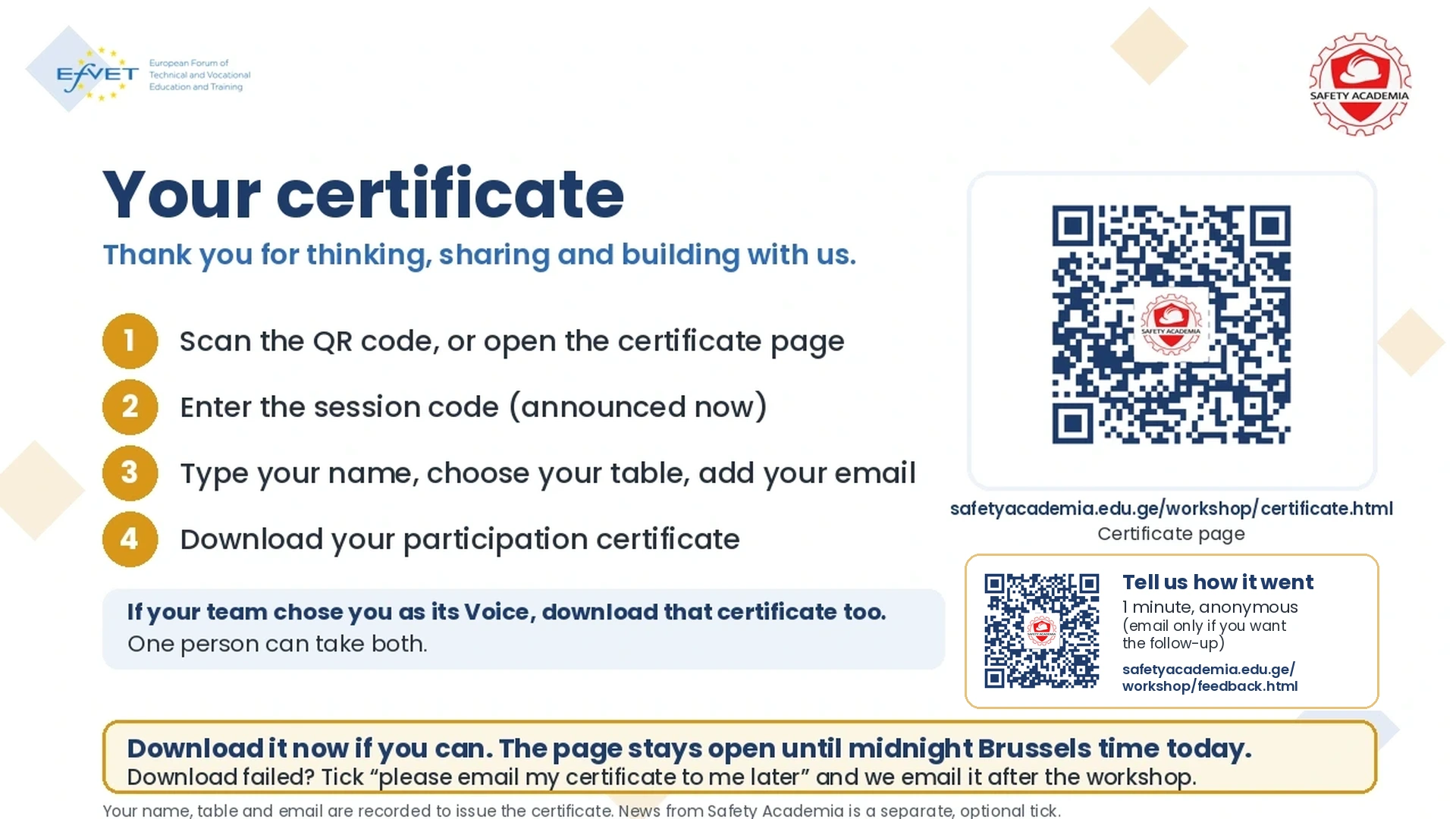
Slide 24: Your certificate: scan the QR code, enter the session code, type your name, choose your table, add your email and download. Open until midnight Brussels time. A second, smaller QR code: Tell us how it went (1 minute, anonymous) at safetyacademia.edu.ge/workshop/feedback.html.
Your certificate: scan the QR code, enter the session code, type your name, choose your table, add your email and download. Open until midnight Brussels time.
Vote on your phone: Question 1 (start)Question 2 (end)QR 3: best table

Scan the QR on slide 11, 21 or 23, tap A, B, C or D, press Submit. Anonymous. If it fails, show your answer with 1–4 fingers.

1 / 24

← Back to the hub